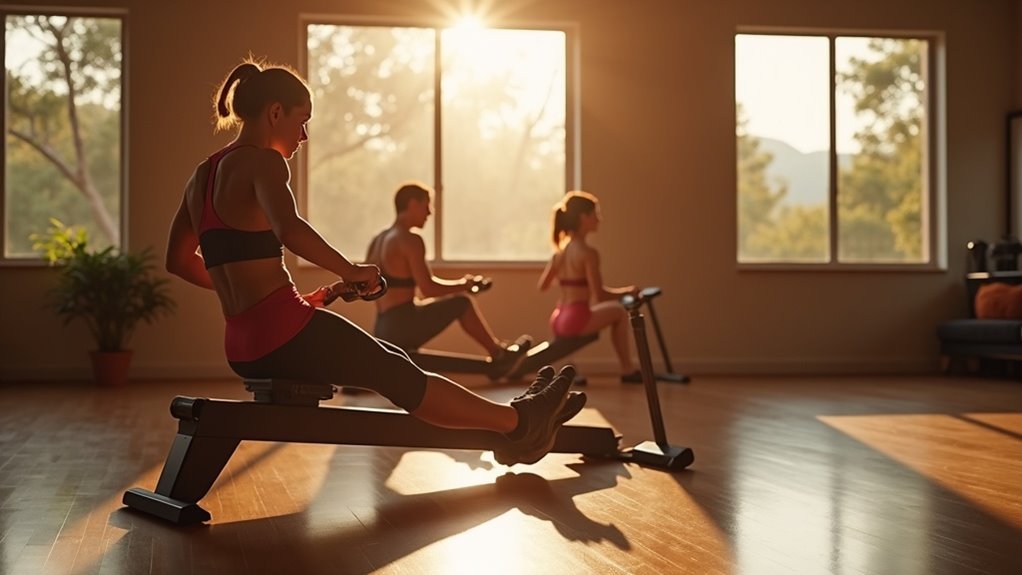
Yes, the damper setting on your rowing machine significantly impacts your technique while working out at home. Higher settings increase resistance, which can lead to hurried strokes and an overreliance on strength. In contrast, lower settings encourage smoother strokes and better form, making them ideal for effective home workouts. For most users, especially beginners, adjusting the damper to a setting between 3-5 is recommended to achieve optimal technique. Proper adjustments not only enhance your rowing efficiency but also help reduce the risk of injury. Looking to boost your performance even more? Explore our resources on maximizing your rowing workouts at home for a healthier lifestyle.
Key Takeaways
- Higher damper settings (7-10) can lead to rushed strokes and an overreliance on strength, which can negatively affect rowing technique at home workouts.
- Lower damper settings (1-4) promote smoother strokes and improve proper technique, making them ideal for both men and women who are beginners practicing at home.
- A recommended damper setting for enhancing technique lies between 3-5, as it helps rowers maintain correct body positioning and sequencing during their at-home sessions.
- Adjusting damper settings directly impacts the drag factor, which is essential for consistent performance and effective force application during home rowing workouts.
- Regularly assessing and adjusting damper settings can help prevent technical flaws and inefficiencies, allowing for better rowing form and overall fitness during at-home exercise routines.
Understanding Damper Settings and Their Impact on Technique
While it may not be immediately obvious, the damper setting on your rowing machine is crucial for optimizing your home workout technique.
Higher damper settings (7-10) increase resistance, making the flywheel feel heavier and potentially compromising your rowing form. This can lead to rushing your strokes or relying too much on brute strength instead of proper sequencing.
Higher damper settings can hinder your rowing form, leading to rushed strokes and reliance on strength over technique.
On the other hand, lower damper settings (1-4) promote a faster flywheel spin, which encourages smoother strokes and better technique—essential for effectively engaging nearly 85% of your muscles.
For the best results, aim to maintain a damper setting between 3-5. This balance not only enhances your technique but also minimizes the risk of injury, ensuring you get the most out of your at-home workouts.
Take the time to experiment and find the setting that works best for you.
The Role of Drag Factor in Rowing Performance
Understanding damper settings is just the beginning; the drag factor plays a crucial role in your home rowing workouts. It measures the flywheel’s deceleration rate between strokes, allowing you to gauge your true effort. A higher drag factor means increased resistance, requiring you to exert more force, which can influence your technique and efficiency.
Performance monitors on rowing machines calculate this factor, providing essential feedback for your home gym sessions. Since different rowing machines have varying drag factor ranges, adjusting the damper setting is vital for consistency in your workouts.
Maintaining an ideal drag factor ensures you apply the right force through your legs, core, and arms, helping you preserve form and enhance overall performance as you strive for your fitness goals at home.
Finding the Right Damper Setting for Your Experience Level
To enhance your home rowing experience, selecting the right damper setting according to your experience level is essential.
| Experience Level | Recommended Damper Setting |
|---|---|
| Beginners | 3-5 |
| Intermediate | 4-6 |
| Advanced | 7-10 |
| Focus | Proper form and technique |
| Safety | Prevents injury |
For beginners, starting with a lower damper setting allows you to master proper rowing technique without excessive strain, making it ideal for those new to home fitness. Intermediate rowers can find a balance between endurance and strength with moderate settings, while advanced users should focus on maintaining technique at higher intensities to maximize workout effectiveness. Regular adjustments are vital for ensuring safe and productive training sessions in your home gym.
Common Rowing Mistakes Related to Damper Settings
Many individuals engaging in home rowing workouts make critical errors by misusing damper settings, often opting for higher levels that compromise their technique.
This overemphasis on resistance can lead to rushing through the recovery phase, sacrificing efficiency and increasing the risk of injury.
To enhance your home fitness performance, it’s essential to focus on proper technique at lower damper settings, which will help you develop effective rowing mechanics and promote overall health and fitness.
Incorrect Damper Setting Usage
While it might seem intuitive to increase the damper setting for a more challenging rowing experience, doing so can lead to significant technical flaws and inefficiencies, especially for those exercising at home.
Many beginners tend to default to higher damper settings, which can hinder workout effectiveness and lead to muscle exhaustion.
Instead, consider the advantages of using lower damper settings in your home gym routine:
- Promotes proper rowing technique by encouraging leg engagement first, which is essential for maximizing your workout.
- Enhances overall workout efficiency during aerobic sessions, making your home exercise sessions more effective.
- Reduces the risk of injury by focusing on form rather than relying on false resistance, allowing you to enjoy a safer workout experience.
Neglecting Technique Focus
Neglecting technique focus when using high damper settings can severely undermine your home rowing workouts, as improper body sequencing leads to inefficient strokes and unnecessary muscle strain.
Many beginners in home fitness mistakenly believe that higher damper settings result in better workouts, but this often compromises proper form. Rushing the recovery phase and misaligning the drive can further exacerbate these issues.
By adopting a lower damper setting of 3-5, you can concentrate on your rowing technique, enhancing efficiency while effectively engaging nearly 85% of your muscles.
Prioritizing technique over excessive resistance not only helps prevent muscle exhaustion but also maximizes cardiovascular benefits. This approach ensures a safer and more effective workout, whether you’re a man or woman dedicated to staying fit and healthy at home.
Overemphasis on Resistance
Overemphasizing resistance during home rowing workouts can significantly undermine your fitness goals. Many individuals mistakenly associate higher damper settings with increased resistance, leading to a focus on strength rather than the essential elements of technique and cardiovascular fitness.
This misalignment can lead to:
- Poor stroke sequencing and rushed recovery phases
- Increased risk of injury due to compromised efficiency
- Muscle fatigue before reaping the cardiovascular benefits
Experienced rowers often steer clear of high damper settings, typically choosing levels 3-5 to maintain proper form.
By prioritizing technique over sheer strength, you not only boost performance but also ensure a safer, more effective home workout.
Importance of Proper Body Positioning on the Rowing Machine
Proper body positioning on the rowing machine is crucial for maximizing your efficiency and power output while exercising at home.
By maintaining a neutral spine and executing the correct body sequence during strokes—legs, back, and arms—you can engage nearly 85% of your muscles effectively. This is especially beneficial for both men and women looking to enhance their home workout routines.
Additionally, using a consistent grip technique with a straight line from elbow to wrist stabilizes your movements, ensuring peak performance and helping you achieve your fitness goals from the comfort of your own space.
Body Sequence During Stroke
When you initiate a rowing stroke with the correct body sequence at home, you not only maximize your power output but also enhance overall efficiency in your workout. Proper form begins with your legs driving the motion, then your core engages, and finally, your arms complete the stroke. This sequence is vital, especially when adjusting your damper setting to manage air resistance and workout intensity effectively.
- Keep your shins nearly vertical at the catch for optimal positioning.
- Ensure the recovery phase lasts twice as long as the drive to maintain rhythm.
- Engaging 85% of your muscles transforms rowing into an effective full-body workout.
Practicing this sequence not only promotes safety but also helps you achieve ideal stroke mechanics, making your home gym experience more rewarding.
Maintaining Neutral Spine
Maintaining a neutral spine is crucial for effective workouts at home, particularly when using rowing machines or similar equipment. A neutral spine, characterized by a straight line from head to tailbone, minimizes back strain while optimizing power transfer during exercises. Engaging your core muscles not only helps prevent injury but also enhances your overall fitness routine.
To achieve a neutral spine, focus on proper technique: avoid rounding or overarching your back. Pay attention to body sequencing—using your legs, back, and arms in a coordinated manner ensures proper form during each stroke.
Regularly assess your posture, keeping your shoulders relaxed and spine aligned even when faced with resistance. This attention to detail not only improves your exercise form but also maximizes efficiency, making your home workouts safer and more effective.
Proper Grip Technique
A correct grip technique on the rowing machine is essential for maximizing performance and minimizing injury risk, especially for those exercising at home. Here’s how to ensure you’re using the right technique:
- Hold the handle with your fingers, maintaining a straight line from your elbow to your wrist to promote effective strokes.
- Keep your elbows close to your body at the finish position. This reduces shoulder strain, which is crucial when you’re working out solo at home.
- Maintain a relaxed grip to facilitate smoother strokes and prevent unnecessary tension, allowing you to focus on your overall workout.
This proper grip technique supports body alignment, promoting a neutral spine and efficient stroke mechanics.
By emphasizing this technique, you enhance your control over the rowing machine, reduce the risk of injury, and effectively manage resistance during your home workouts.
Stay fit and healthy while making the most out of your home gym equipment!
The Significance of the Recovery Phase in Rowing
Although often overlooked, the recovery phase in your workout routine plays a critical role in optimizing overall efficiency and muscle performance. This phase should take twice as long as the exertion phase, allowing for muscle recovery and better body positioning.
Rushing through recovery can compromise your technique and lead to strain. Focus on maintaining a controlled recovery pace by counting during your reps, ensuring smooth and deliberate movements.
Proper sequencing—initiating movements from your core, followed by your arms and legs—enhances momentum and prepares you for the next set.
How to Enhance Your Rowing Warm-Up Routine
To enhance your home rowing warm-up routine, it’s essential to prepare your body through targeted mobility and progressive intensity exercises.
Begin with 2-3 minutes of mobility exercises to focus on key joints, then spend 3-5 minutes gradually increasing rowing intensity, emphasizing proper technique to maximize your performance.
Keep these points in mind:
- Incorporate joint-specific mobility exercises for your ankles, hips, spine, and shoulders to keep your body flexible and injury-free.
- Gradually ramp up your rowing intensity while ensuring controlled movements to build endurance and strength.
- Synchronize your breathing with the stroke phases to improve efficiency and overall workout effectiveness.
Neglecting a warm-up can hinder your performance and increase the risk of injury, highlighting the importance of a consistent routine for anyone looking to optimize their home training regimen.
Tips for Maintaining Good Form While Rowing at Home
Maintaining good form while rowing at home is crucial for maximizing your performance and minimizing the risk of injury, whether you’re a man or a woman.
Start by setting your damper between 3-5, which supports proper technique and helps reduce muscle strain during your workout. Focus on the correct body sequence: drive with legs-back-arms and return with arms-back-legs to enhance your rowing efficiency.
Ensure that your feet are securely strapped in and that the foot stretcher height is comfortable, promoting ideal alignment for your body.
It’s important to maintain a neutral spine and keep your shoulders relaxed to prevent unnecessary tension.
To continually improve, regularly assess your form by filming your sessions or using a mirror to spot common technique mistakes. This practice won’t only elevate your performance but also ensure a safer and more effective rowing experience from the comfort of your home gym.